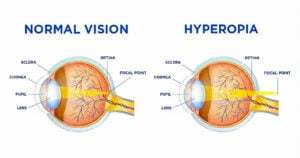
Hyperopia occurs when your eye focuses light behind the retina rather than directly on it. As a result, close-up tasks can blur, and your eyes may tire more quickly, especially after long days on a phone or computer. Laser surgery reshapes the cornea so light focuses where it should, improving visual comfort and reducing the need for glasses.
If you feel frustrated by farsightedness and want a lasting solution, you can start with a consultation to get a clear answer about your candidacy.
What Hyperopia Is and Why It Can Feel So Draining
Hyperopia, also called farsightedness, often comes from a cornea that is too flat or an eye that is slightly shorter than average. Because of that shape, your eyes work overtime to keep things clear, especially up close. Over time, that constant effort can lead to eye strain, headaches, and the feeling that your vision never fully relaxes.
Laser vision correction reshapes the cornea. In other words, it changes how light enters the eye so images land more accurately on the retina.
Laser Surgery Options for Hyperopia
At Southwest Eye Institute, your surgeon chooses a procedure based on your cornea, your prescription, and your goals. While your plan remains personal, most qualified patients fall into one of two laser paths.
Hyperopic LASIK
LASIK corrects hyperopia by reshaping the cornea beneath a thin flap. First, your surgeon creates the flap with a femtosecond laser. Next, an excimer laser reshapes the cornea to improve focus. Finally, the surgeon repositions the flap to allow your eye to heal naturally.
Many patients like LASIK because recovery often feels quicker. Even so, candidacymatters, so your surgeon will confirm that LASIK is appropriate for your corneal thickness and overall eye health.
PRK for Hyperopia
PRK treats hyperopia without creating a flap. Instead, your surgeon gently removes the surface layer of the cornea. Then the excimer laser reshapes the cornea to refine focus. After that, the surface layer regrows over several days while your eye heals.
PRK often works well for patients who have thinner corneas or who need a different surgical approach. Recovery usually takes longer than LASIK, but many patients reach excellent vision once healing is complete.
What to Expect From Laser Surgery
Your Consultation Comes First
Your consultation sets the foundation for safe results. During this visit, the Southwest Eye Institute team measures your prescription, maps your cornea, and checks your eye health. We also talk through your lifestyle goals, because your day-to-day needs matter just as much as your numbers.
If laser surgery is not the safest option for your eyes, your surgeon will explain why and outline the next steps. That way, you never feel stuck guessing.
A Quick Procedure, With Comfort Built In
Laser vision correction happens as an outpatient procedure. Your team uses numbing drops to keep you comfortable. The laser portion itself usually takes seconds per eye, and the full visit often feels surprisingly straightforward.
You can go home the same day. Then you start healing with clear guidance and scheduled follow-ups.
Recovery and Follow-Up
Most patients notice improvement early, although vision can fluctuate during healing. For that reason, follow-up visits matter. Your surgeon checks your healing, answers questions, and helps you feel confident about your progress.
You will also receive simple instructions, such as avoiding eye rubbing and protecting your eyes as they recover.
Understand that results vary by prescription and anatomy
A consultation gives you the most straightforward answer. It also gives you peace of mind, because you will know what makes sense for your eyes.
Why Patients Choose Laser Surgery
Patients often choose laser correction because it can make daily life feel easier. For example, you may spend less time searching for glasses, dealing with glare, or struggling through long screen days. You may also feel more confident during travel, workouts, and busy mornings.
Most importantly, you gain a clearer plan. You will understand what the procedure can and cannot do, and what to expect at each step.
Quick Q&A
Can laser surgery correct farsightedness? Yes. LASIK and PRK can correct farsightedness by reshaping the cornea so light focuses more accurately.
How do I know which procedure is correct for me? Your surgeon decides, after a detailed consultation, based on corneal thickness, eye health, and your prescription.
How soon will I see results? Many patients notice clearer vision early, although healing and stabilization take time and vary by procedure.
Schedule a Laser Consultation
Living with hyperopia can turn simple moments into constant effort. Laser surgery can offer a safe, proven path to clearer vision and more freedom in your routine. At Southwest Eye Institute, our surgeons guide you through every step with advanced technology and a plan you can understand.
To provide the best experiences, we use technologies like cookies to store and/or access device information. Consenting to these technologies will allow us to process data such as browsing behavior or unique IDs on this site. Not consenting or withdrawing consent, may adversely affect certain features and functions.
Functional
Always active
The technical storage or access is strictly necessary for the legitimate purpose of enabling the use of a specific service explicitly requested by the subscriber or user, or for the sole purpose of carrying out the transmission of a communication over an electronic communications network.
Preferences
The technical storage or access is necessary for the legitimate purpose of storing preferences that are not requested by the subscriber or user.
Statistics
The technical storage or access that is used exclusively for statistical purposes.The technical storage or access that is used exclusively for anonymous statistical purposes. Without a subpoena, voluntary compliance on the part of your Internet Service Provider, or additional records from a third party, information stored or retrieved for this purpose alone cannot usually be used to identify you.
Marketing
The technical storage or access is required to create user profiles to send advertising, or to track the user on a website or across several websites for similar marketing purposes.