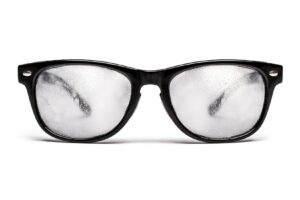
Foggy Glasses? Long-Term Solutions With LASIK, PRK, and EVO ICL
Foggy glasses form when warm, moist air hits a cooler lens, turning into tiny droplets. If you keep wiping your lenses, adjusting your mask, or dealing with blurry interruptions during work, workouts, cooking, or errands, it may be time to think beyond short-term fixes. For many patients, the best long-term answer is reducing their dependence on glasses through modern vision correction.
LASIK, PRK, and EVO ICL can help the right candidates see clearly with less reliance on eyewear. The best option depends on your prescription, corneal health, dry eye risk, age, and long-term goals. Instead of chasing better sprays or wipes, start with a vision correction consultation. That visit can check your prescription stability, corneal shape, and overall eye health. It can also help your surgeon recommend the safest option for your lifestyle and vision needs.
Why Foggy Glasses Keep Happening
Condensation usually causes foggy glasses, not poor lens quality. Warm breath rises and hits a cooler lens surface. Moisture then collects, clouding your view. That is why fogging often gets worse with masks, cold weather, or any situation that pushes warm air toward the top of the frame.
A tighter seal across the top of the mask can help in the moment. The American Academy of Ophthalmology notes that pulling the mask higher over the nose and resting glasses on top can reduce fogging. That trick can help, but it does not solve the larger problem for people who feel tired of wearing glasses every day.
Short-Term Tricks vs. Long-Term Solutions
Anti-fog habits can help, especially when masks or weather trigger the problem. A better frame fit, a tighter seal at the nose, and cleaner lenses may reduce fogging for a while. But those fixes still require maintenance. They do not change the fact that many patients want to rely less on glasses altogether.
That is where modern vision correction comes in. LASIK, PRK, and EVO ICL all reduce dependence on glasses or contacts, but each one works in a different way. The best choice is the one that fits your eyes safely, not the one that sounds fastest online.
Modern Vision Correction Is More Than LASIK
Many people assume LASIK is the only real answer once they start wearing down from foggy glasses. That is not true. Not everyone qualifies for LASIK. The Refractive Surgery Council says about 15-20% of patients do not qualify. That is one reason PRK and implantable lens options matter. Your candidacy depends on your prescription, prescription stability, eye health, corneal thickness, corneal shape, and expectations.
At Southwest Eye Institute, the vision correction lineup goes beyond LASIK. The practice offers LASIK, PRK, EVO ICL, and other options. That allows the team to match patients to the safest option for their eyes, rather than forcing a one-size-fits-all procedure.
LASIK for People Who Want Speed and Convenience
LASIK reduces dependence on glasses or contact lenses. It reshapes the cornea so light can focus more accurately on the retina. At Southwest Eye Institute, modern LASIK offers active adults a faster, more personalized option for clearer vision.
LASIK often works well for adults with mild to moderate nearsightedness, farsightedness, or astigmatism. Good candidates also need healthy corneas with enough thickness for safe treatment. Southwest Eye Institute notes that many patients notice significant improvement in vision within about 24 hours and quickly return to normal routines.
PRK for Patients Who Need a Different Laser Option
PRK is another laser vision correction procedure, but it works differently from LASIK. Instead of creating a flap, PRK removes corneal tissue to improve focus. It can correct nearsightedness, farsightedness, and astigmatism. Surgeons often consider it when LASIK is not the safest fit.
PRK can help patients with thinner corneas or other corneal factors that make a flap less ideal. The tradeoff is recovery. The Refractive Surgery Council notes that healing takes several days. Vision can take up to three months to fully settle. Southwest Eye Institute also explains that PRK usually requires more healing time, more medication, and closer follow-up than LASIK.
EVO ICL for Higher Prescriptions, Thin Corneas, or Dry Eye Concerns
EVO ICL works differently from both LASIK and PRK. It does not reshape the cornea. Instead, the surgeon places an implantable lens inside the eye to improve focus. No corneal tissue gets removed. The Refractive Surgery Council notes that implantable lenses can help patients whose prescriptions are too strong for laser vision correction or whose corneas are not ideal for it.
Southwest Eye Institute’s LASIK vs. EVO ICL guidance makes the difference clear. LASIK often works better for mild to moderate prescriptions and healthy, thicker corneas. EVO ICL often fits higher prescriptions, thinner corneas, or patients with dry eye concerns. For the right person, EVO ICL can offer a very practical long-term answer to foggy glasses.
What Vision Correction Does Not Always Fix
This part matters. No vision correction procedure is magic. Even if you want to stop dealing with foggy glasses, you still need realistic expectations. The FDA notesthat some patients still need glasses or contacts after surgery. People who needed reading glasses before surgery may still need them afterward. That becomes even more important as near-vision changes show up with age.
Southwest Eye Institute also notes that the natural lens changes over time. In some patients, a lens-based procedure is preferable to LASIK or EVO ICL. So if you are over 40 and frustrated by foggy glasses, your best answer may depend on more than distance vision alone.
How to Decide if Foggy Glasses Are Your Sign to Explore Surgery
If foggy glasses only bother you once in a while, a better fit and simple anti-fog steps may be enough. But if glasses create daily friction during exercise, travel, childcare, work, or everyday life, ask yourself a different question. Do you still want to depend on glasses at all? That question often leads patients into a conversation about modern vision correction.
The next step is a proper consultation. A candidacy workup can determine whether LASIK, PRK, EVO ICL, or another option is appropriate for your prescription, corneas, tear film, and long-term goals. At Southwest Eye Institute, that is where the right fit becomes clear.
Find Out Whether You Can Rely Less on Glasses
If foggy glasses are slowing you down, schedule a vision correction consultation at Southwest Eye Institute. A personalized exam can show whether LASIK, PRK, EVO ICL, or another approach is the safest fit for your eyes and help you move toward clearer, more convenient vision.
FAQ: Foggy Glasses and Long-Term Solutions
Foggy glasses form when warm, moist air hits a cooler lens, turning into tiny droplets. It often gets worse when air escapes upward from a mask or when you move between different temperatures.
LASIK can reduce your dependence on glasses, potentially eliminating fogging during many daily activities. But it does not guarantee that you will never need glasses again, especially later in life or for near-vision tasks.
It can be. PRK does not require a corneal flap, so surgeons often consider it for patients with thinner corneas or related concerns.
For some patients, yes. Southwest Eye Institute notes that EVO ICL may be a better fit for dry eye patients because it does not remove corneal tissue or affect the eye surface the way LASIK can.
Not qualifying for LASIK does not end the conversation. The Refractive Surgery Council and Southwest Eye Institute both note that PRK or implantable lenses may still work well, depending on your prescription, corneas, and eye health.
Possibly. The FDA says some patients still need glasses after surgery. Age-related near-vision changes can still become part of the picture even after successful distance correction.
They may help if masks or weather cause the problem. But if glasses frustrate you every day, those products may only address the symptom, not the dependence on eyewear itself.
Start with a vision correction consultation. A full exam can show whether LASIK, PRK, EVO ICL, or another option is safest and most likely to give you clearer vision with less dependence on glasses.
Related Posts
Better Vision Starts Here!
If you’re experiencing vision changes, don’t wait until they worsen. Schedule your eye exam today!
To provide the best experiences, we use technologies like cookies to store and/or access device information. Consenting to these technologies will allow us to process data such as browsing behavior or unique IDs on this site. Not consenting or withdrawing consent, may adversely affect certain features and functions.
Functional
Always active
The technical storage or access is strictly necessary for the legitimate purpose of enabling the use of a specific service explicitly requested by the subscriber or user, or for the sole purpose of carrying out the transmission of a communication over an electronic communications network.
Preferences
The technical storage or access is necessary for the legitimate purpose of storing preferences that are not requested by the subscriber or user.
Statistics
The technical storage or access that is used exclusively for statistical purposes.The technical storage or access that is used exclusively for anonymous statistical purposes. Without a subpoena, voluntary compliance on the part of your Internet Service Provider, or additional records from a third party, information stored or retrieved for this purpose alone cannot usually be used to identify you.
Marketing
The technical storage or access is required to create user profiles to send advertising, or to track the user on a website or across several websites for similar marketing purposes.