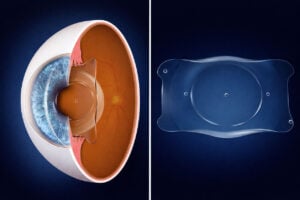
When you start comparing EVO ICL vs LASIK, it helps to know that both can dramatically reduce your dependence on glasses or contacts, but they work in very different ways. LASIK reshapes the cornea with a laser, while EVO ICL adds a tiny lens inside the eye that can be removed or replaced later, so the “better” choice depends on your prescription, corneathickness, dry eye risk, and what you want long term.
LASIK is usually best for adults with mild to moderate nearsightedness, farsightedness, or astigmatism, and for those with healthy, adequately thick corneas. At the same time, EVO ICL tends to be a good fit for people with high prescriptions, thinner corneas, or concerns about dry eye. At Southwest Eye Institute in El Paso, surgeons Dr. De la Torre and Dr. Calvin McNelly offer both LASIK and EVO ICL, so your free consultation is about matching the right procedure.
If you’re between 21 and 60 and want to reduce or eliminate the need for glasses or contacts, this guide will help you compare your options and get started with a FREE vision correction consultation.
How LASIK Works
LASIK is a laser vision correction procedure that reshapes the cornea, the front surface of the eye, so light focuses more accurately on the retina. A femtosecond laser creates a thin flap; an excimer laser reshapes the underlying cornea in seconds; then the flap is smoothed back into place.
What LASIK Treats
Nearsightedness (myopia)
Farsightedness (hyperopia)
Astigmatism
Benefits of LASIK:
Speedy visual recovery, often within 24 to 48 hours, for everyday activities
Clear vision with reduced dependence on glasses or contacts
EVO ICL is different than LASIK. Instead of reshaping the cornea, your surgeon places an ultra-thin, flexible ImplantableCollamerLens behind the iris and in front of your natural lens. The lens works with your eye’s existing optics to focus light more accurately, and no corneal tissue is removed.
What EVO ICL Treats
Nearsightedness (Myopia)
Astigmatism – with the EVO Toric ICL lens
Moderate to very high prescriptions (often higher than LASIK can safely treat)
Benefits of EVO ICL
Sharp, high-quality vision, especially for moderate to high prescriptions
Does not remove corneal tissue
Excellent option for patients who may not qualify for LASIK or PRK
A biocompatible lens designed to work naturally with your eye
Reversible and removable if needed
Fast recovery with minimal discomfort
Long-lasting vision correction
Built-in UV protection
Typically, it does not cause dry eye symptoms like LASIK may.
Designed to treat moderate to high nearsightedness, often beyond safe LASIK ranges
It can be a better choice for thin corneas or corneas at higher risk of weakening
The procedure typically takes 20 to 30 minutes per eye, with numbing drops for comfort and a small corneal incision that often does not require stitches.
EVO ICL vs LASIK: Key Differences That Matter
When you compare EVO ICL vs LASIK, you are really comparing two very different philosophies of vision correction.
How they work
LASIK: Uses a laser to reshape the cornea permanently.
EVO ICL: Adds a thin lens inside the eye without removing corneal tissue.
Reversibility
LASIK: Permanent corneal reshaping cannot be entirely “undone.”
EVO ICL: The lens can be removed or replaced as needed, providing greater flexibility if your prescription changes later.
Prescription range
LASIK: Generally best for mild to moderate refractive errors.
EVO ICL: Often preferred for higher myopia, sometimes up to −20.00 diopters, and for patients pushing the safe LASIK range.
Cornea thickness and shape
LASIK: Requires adequate corneal thickness and shape to leave enough tissue for long-term safety.
EVO ICL: Does not thin the cornea, so it can be an option for thinner corneas or when corneal tissue is at a premium.
Dry eye considerations
LASIK: Can worsen dry eye symptoms in some patients, especially if dryness is present before surgery.
EVO ICL: Because it does not affect the corneal surface or nerves, it carries minimal risk of inducing dry eye.
Cost
LASIK: Typically less expensive per eye than EVO ICL.
EVO ICL: Usually costs more, in part because of the custom lens itself and the complexity of lens implantation.
Both procedures have excellent safety records when performed by experienced surgeons. The safest choice is the one that matches your anatomy, prescription, and lifestyle.
Your nearsightedness is high, above the typical LASIK range
Your corneas are thin, borderline, or have subtle irregularities
You have a history of dry eye or are worried about dry eye after surgery
You prefer a reversible option that preserves corneal tissue
EVO ICL is often recommended for:
People who have been told they are “not a LASIK candidate” because of their prescription or cornea thickness
Patients who want the flexibility of a removable lens in case their vision changes later
Night drivers and detail-oriented professionals who value crisp vision and are comfortable with a higher upfront investment
LASIK vs EVO ICL: Age, Lifestyle, And Long-Term Planning
Your age and lifestyle also matter when comparing EVO ICL vs. LASIK.
Adults in their 20s and 30s with stable prescriptions and healthy corneas often opt for LASIK for its speed and simplicity.
Adults with higher prescriptions or thinner corneas may be better candidates for EVO ICL, even in their 20s and 30s, because it preserves corneal structure and covers a wider range of prescriptions.
In your 40s and 50s, the natural lens starts to change. Sometimes a lens-based procedure, rather than LASIK or EVO ICL, is the better long-term play, especially if cataracts are beginning to form.
At Southwest Eye Institute in El Paso, Dr. De la Torre and Dr. McNelly consider not only how you see now, but also what will make sense as your eyes age. That is where programs like “Vision for Life” can help connect current decisions with long-term planning, should an adjustment to your eye be needed.
Take The Next Step Toward Clearer Vision
If you are ready to stop guessing about EVO ICL vs LASIK and want a personalized, honest recommendation, request a free LASIK consultation in El Paso at Southwest Eye Institute with Dr. De la Torreor Dr. McNelly so they can examine your eyes, explain whether LASIK, EVO ICL, or another vision correction path is safest for your prescription, and help you move toward more precise, more confident vision without relying on glasses or contacts every day.
FAQ: EVO ICL vs LASIK
Both procedures have excellent safety records when performed by experienced surgeons, and serious complications are rare. EVO ICL avoids corneal thinning and may be better for certain high-risk corneas, while LASIK avoids placing a device inside the eye. The safest choice is the one that matches your eye anatomy, prescription, and health.
Yes, EVO ICL is designed to stay in place indefinitely, and for most people, it works as a long-term solution just like LASIK. The key difference is that the EVO ICL lens can be removed or exchanged if medically necessary, while LASIK involves permanent corneal reshaping.
For patients with thin or borderline corneas, EVO ICL is often preferred because it does not remove corneal tissue. LASIK requires a specific minimum corneal thickness to be performed safely, so thin corneas can make LASIK risky or rule it out entirely.
EVO ICL is usually the frontrunner for very high levels of nearsightedness, especially beyond the safe treatment range for LASIK. LASIK is excellent for mild to moderate refractive errors, but as prescriptions become more complex, preserving corneal strength and visual quality often tips the balance toward EVO ICL.
LASIK generally has the fastest visual recovery, with many people seeing well enough to drive within about a day or two. EVO ICL vision often improves quickly, too, but it can take several days to a couple of weeks for vision and comfort to fully stabilize, depending on the individual eye.
If you have moderate dry eye or are very concerned about dry eye after surgery, EVO ICL may be a better option because it does not affect the corneal surface or nerves. LASIK can worsen dryness in some patients, especially early in the healing period, although many people do very well with proper dry eye management.
EVO ICL typically has a higher upfront cost than LASIK because of the custom lens and more complex procedure, but the value depends on your situation. For someone who is not a good LASIK candidate or who needs treatment for very high myopia, the extra cost can be worth it to get safe, stable vision without corneal thinning.
Yes. People who have LASIK or EVO ICL can still go on to have cataract surgery or lens-based procedures later in life. With EVO ICL, your surgeon may choose to remove the lens during cataract surgery. With LASIK, your surgeon considers your prior corneal reshaping when planning the lens power.
If neither LASIK nor EVO ICL is suitable for your eyes, there are still options, such as PRK, specialty contact lenses, or lens-based surgery in certain age groups. Your free consultation at Southwest Eye Institute is about getting honest answers, not forcing you into a procedure that is not right for you.
Related Posts
Better Vision Starts Here!
If you’re experiencing vision changes, don’t wait until they worsen. Schedule your eye exam today!
To provide the best experiences, we use technologies like cookies to store and/or access device information. Consenting to these technologies will allow us to process data such as browsing behavior or unique IDs on this site. Not consenting or withdrawing consent, may adversely affect certain features and functions.
Functional
Always active
The technical storage or access is strictly necessary for the legitimate purpose of enabling the use of a specific service explicitly requested by the subscriber or user, or for the sole purpose of carrying out the transmission of a communication over an electronic communications network.
Preferences
The technical storage or access is necessary for the legitimate purpose of storing preferences that are not requested by the subscriber or user.
Statistics
The technical storage or access that is used exclusively for statistical purposes.The technical storage or access that is used exclusively for anonymous statistical purposes. Without a subpoena, voluntary compliance on the part of your Internet Service Provider, or additional records from a third party, information stored or retrieved for this purpose alone cannot usually be used to identify you.
Marketing
The technical storage or access is required to create user profiles to send advertising, or to track the user on a website or across several websites for similar marketing purposes.


 What LASIK Treats