If you have been told you are “not a candidate for LASIK”, vision correction for thin corneas is still absolutely possible. You may just need a different approach. At Southwest Eye Institute, our refractive surgeons, Dr. Javier De la Torre and Dr. Calvin McNelly, use advanced testing and proven procedures to help many patients with thin corneas safely reduce their dependence on glasses and contacts.
Why Corneal Thickness Matters for Vision Correction
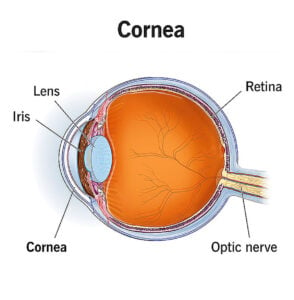
Your cornea is the clear, dome-shaped “front window” of your eye. In procedures like LASIK, a laser reshapes the cornea to correct nearsightedness, farsightedness, and astigmatism. That reshaping process removes an exact amount of tissue. If the cornea is already too thin, removing more tissue can weaken it and increase the risk of long-term complications, such as post-surgical corneal instability or ectasia.
Clinically, this means:
Having thin corneas does not, by itself, affect your vision.
It does influence which vision correction or treatment options are safest for you.
It makes detailed, advanced diagnostic testing an essential part of your care, not an optional step.
LASIK is popular for a reason: it is fast, effective, and offers quick recovery for many patients. However, LASIK involves creating a thin flap in the cornea, then reshaping the underlying tissue with a laser. For someone with thin corneas, the flap, combined with the additional tissue removal, may leave the cornea too weak.
If your eye doctor says:
“Your corneas are too thin for LASIK.”
They usually mean:
“We do not want to remove too much tissue and risk your long-term corneal health.”
At Southwest Eye Institute, Dr. Javier De la Torre and Dr. Calvin McNelly routinely see patients who have been told “no” to LASIK due to thin corneas, dry eye, or high prescriptions and help them explore safe alternatives, such as PRK and Refractive Lens Exchange.
PRK: A Proven Laser Option for Thin Corneas
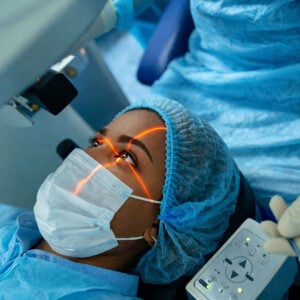
Photorefractive keratectomy (PRK) is one of the most trusted alternatives to LASIK for patients with thin corneas. It uses a laser to reshape the cornea, similar to LASIK, but without creating a corneal flap. Instead, the surface layer (epithelium) is gently removed, the cornea is reshaped, and the surface layer regrows during recovery.
Why PRK can be safer for thin corneas
No flap creation means we preserve more structural strength
More tissue left behind reduces the risk of long-term corneal weakening
Ideal for some patients with thin corneas, irregular corneas, or jobs and hobbies with a higher risk of eye trauma, such as military work, first responders, or contact sports
Both Dr. De la Torre and Dr. McNelly perform PRK and tailor the procedure to your specific corneal thickness and prescription.
Refractive Lens Exchange (RLE): A LASIK Alternative That Skips the Cornea
For patients in their 40s and beyond, especially those with reading difficulties, Refractive Lens Exchange (RLE) can be an excellent option that is independent of corneal thickness.
RLE is similar to cataract surgery. Instead of reshaping the cornea, your surgeon replaces your natural lens with a custom artificial intraocular lens (IOL) designed to correct your refractive error.
At Southwest Eye Institute, RLE is performed by Dr. Calvin McNelly, who also performs LASIK and PRK. He is currently the only surgeon at our practice who performs this specific lens-based procedure.
Why RLE works well for some thin-cornea patients
Does not remove corneal tissue at all
Can address nearsightedness, farsightedness, astigmatism, and presbyopia
Prevents future cataracts in that eye, since the lens has already been replaced
Considerations with RLE
It is more invasive than LASIK or PRK
Recovery is typically measured in days to weeks
As with any lens surgery, there is a small risk of complications like glare, halos, or infection.
What To Expect At Your Vision Correction Evaluation
Your path to vision correction for thin corneas starts with a detailed exam and imaging. You can expect your visit to include:
Discussion of your job, hobbies, and goals, for example, “I never want to wear readers,” or “I just want to ditch contacts for sports.”
From there, Dr. Javier De la Torre or Dr. Calvin McNelly will outline which procedures are safe for your corneal thickness and which are not. They will then personalize a recommendation, whether that is LASIK, PRK, RLE, or a non-surgical strategy.
FAQ: Vision Correction for Thin Corneas
Can I ever have LASIK if I have thin corneas?
It depends on how thin your corneas are and how much tissue would need to be removed to correct your prescription. Some studies suggest that LASIK can still be safe in select patients with slightly thinner-than-average corneas, but caution is warranted. At Southwest Eye Institute, your surgeon will only recommend LASIK if the corneal thickness and shape meet strict safety criteria. If not, PRK or RLE may be a better fit.
Is PRK safer than LASIK for thin corneas?
For many thin-cornea patients, yes. PRK avoids creating a corneal flap and preserves more tissue, helping maintain structural strength and reducing certain flap-related risks. The trade-off is a slower, more gradual recovery.
How long does recovery take after PRK?
Most patients can return to light activities within a few days, but vision may be hazy at first and continue to sharpen over several weeks. The exact timeline depends on your prescription, healing response, and work demands. Your surgeon will review realistic expectations with you during your consultation.
Who is a good candidate for Refractive Lens Exchange (RLE)?
RLE is usually best for patients over 40 who have thin corneas, are already noticing presbyopia, or want to avoid cataract surgery in the future. It is less often recommended for younger patients with healthy natural lenses.
What is the first step if I have been told “no” to LASIK?
The first step is to obtain a second opinion with a comprehensive refractive work-up. At Southwest Eye Institute, we will confirm your corneal thickness and shape, explain why LASIK was not recommended, and guide you through alternatives such as PRK and RLE that may still provide you with life-changing visual freedom.
Ready to Find Out Which Vision Correction Option Is Safe for Your Thin Corneas?
Request a free LASIK consultation with Southwest Eye Institute today to get a personalized treatment plan and clear answers about your next steps. Whether your best option is PRK, Refractive Lens Exchange, or a carefully optimized non-surgical plan, the team at Southwest Eye Institute is committed to prioritizing your long-term eye health.
Related Posts
Better Vision Starts Here!
If you’re experiencing vision changes, don’t wait until they worsen. Schedule your eye exam today!
To provide the best experiences, we use technologies like cookies to store and/or access device information. Consenting to these technologies will allow us to process data such as browsing behavior or unique IDs on this site. Not consenting or withdrawing consent, may adversely affect certain features and functions.
Functional
Always active
The technical storage or access is strictly necessary for the legitimate purpose of enabling the use of a specific service explicitly requested by the subscriber or user, or for the sole purpose of carrying out the transmission of a communication over an electronic communications network.
Preferences
The technical storage or access is necessary for the legitimate purpose of storing preferences that are not requested by the subscriber or user.
Statistics
The technical storage or access that is used exclusively for statistical purposes.The technical storage or access that is used exclusively for anonymous statistical purposes. Without a subpoena, voluntary compliance on the part of your Internet Service Provider, or additional records from a third party, information stored or retrieved for this purpose alone cannot usually be used to identify you.
Marketing
The technical storage or access is required to create user profiles to send advertising, or to track the user on a website or across several websites for similar marketing purposes.